The view from a cave mouth at first light, looking out over hazy blue-grey mountain ridges that fade to gold at the horizon.

Companion device for aging parents

AL

Never alone, never a burden.

Patient answers for them. Peace of mind for you. AL remembers the little things, keeps the family close, and never tires of a question.

Why AL exists

Made for the questions that come back.

The same question, a few minutes later, is brand new to the person asking. AL is built on one small promise: the tenth reply is as warm as the first. No sighing. No keeping score.

  1. 9:12 am

    Did I take my pills?

    You did, right after breakfast. The little blue one too.

  2. 9:26 am

    Did I take my pills?

    You did. All set until tonight.

  3. 9:51 am

    Did I take my pills?

    Yes, all taken. Maya will be glad to hear you're keeping up.
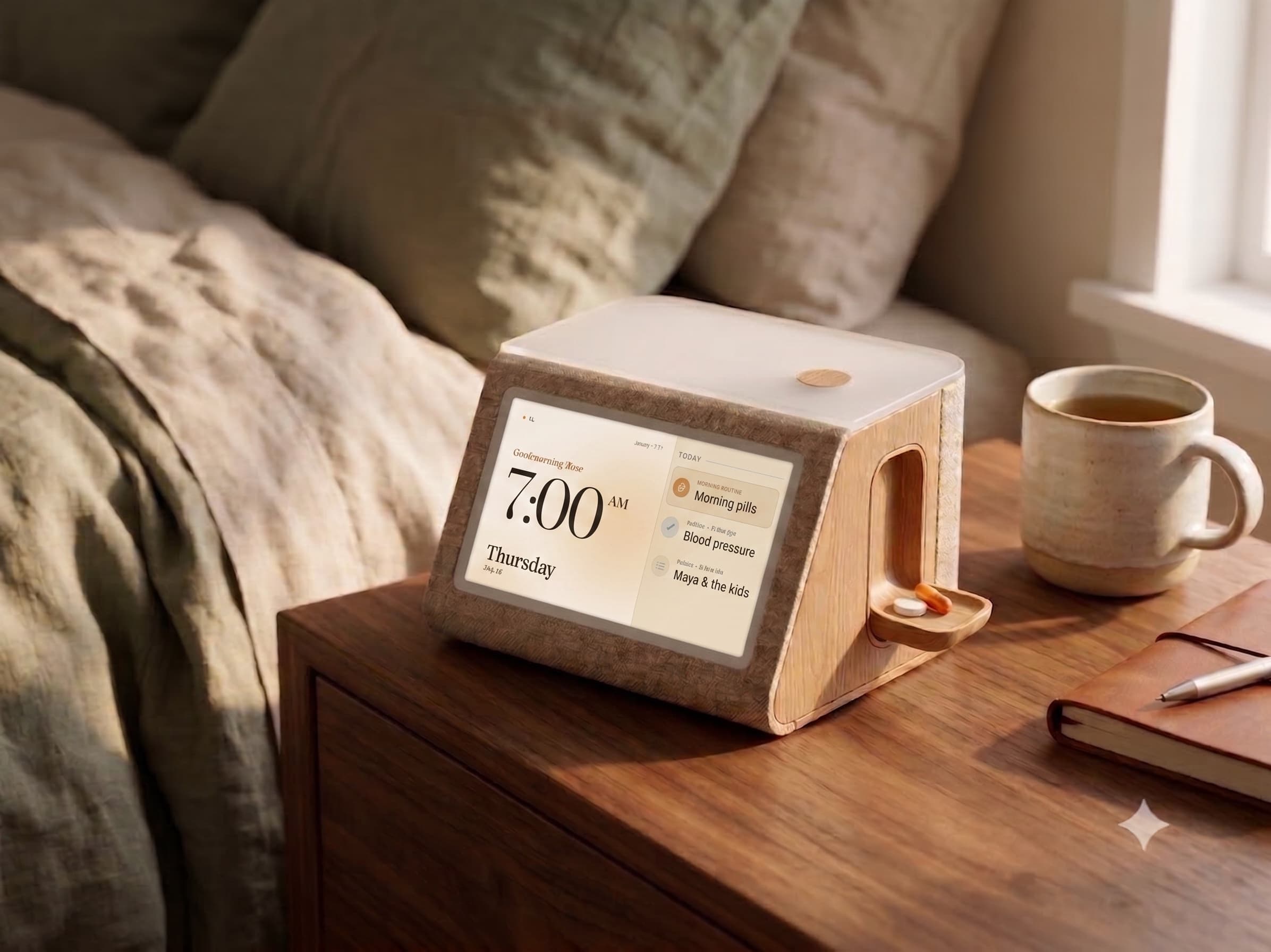
AL on a wooden nightstand at dawn: a small oak-and-felt device whose warm always-on screen shows the time, the day, and today's plans, with a little tray holding the morning's pills, beside a mug of tea.
This is AL. It lives on the nightstand and answers, every time.

Why now

One home, and millions more.

The country is growing older faster than it can care for itself. The math is already against us.

1 in 5

Americans will be over 65 by 2030, one of the fastest-aging stretches in the country's history.

9.3M

caregiving jobs will need filling by 2031, more than any other occupation, with nowhere near enough workers to fill them.

53M

family members are already caring for someone, most of them unpaid and stretched thin.

And almost none of the technology meant to help was built for them. Even Alexa and Google Home leave most older adults frustrated. AL starts from the other end, designed for the person asking, not the person setting it up.

It knows your family

AL remembers, so they don't have to.

AL learns the shape of your family: the names, the routines, the stories behind the photographs. When your dad asks who's coming this weekend, AL answers with the real plan. Maya, on Sunday, and she's taking him to lunch.

The family adds to it as life happens: the surgery went well, the neighbor stops by on Tuesdays. AL folds it gently into conversation. Nothing to program.

  • Real answers

    Questions get answered from your family's actual life, not generic replies.

  • Familiar company

    Conversation and activities built from their own memories.

  • A baseline for care

    Because AL knows what yesterday sounded like, it can notice when something changes.

What AL does

Small helps, around the clock.

  • Family check-ins

    Text AL the way you'd text a sibling. 'How was Mom's morning?' gets a real answer: doses taken, how she seemed, what she talked about. And what you share flows back into her day.

    The Fam

    How was Mom’s morning?

    A good one. She took her 9 am dose on time, and we sang along to Patsy Cline. She’s looking forward to Maya’s visit on Sunday.

    Tell her Maya is bringing the kids.

    I will. She’ll love that.

  • A gentle eye on cognition

    AL notices what a weekly visit can miss: more questions coming back, new confusion in the afternoons, restless nights. It shares quiet trends with the family. Patterns, not alarms.

  • Little sparks

    A few gentle moments each day: a favorite song from their youth, a saying to finish together, a question about the garden they loved. No scores, no rushing. Designed with the ideas behind the music, reminiscence, and cognitive-stimulation approaches used in dementia care, and made from their own memories.

  • Through the night

    Nights are when worry lives. If someone is up and unsettled at 3 a.m., AL is awake too: a calm voice, a gentle steer back toward bed, and a note for the family in the morning. If something truly needs you, you'll know right away.

On the kitchen counter

Small enough to forget it’s there.

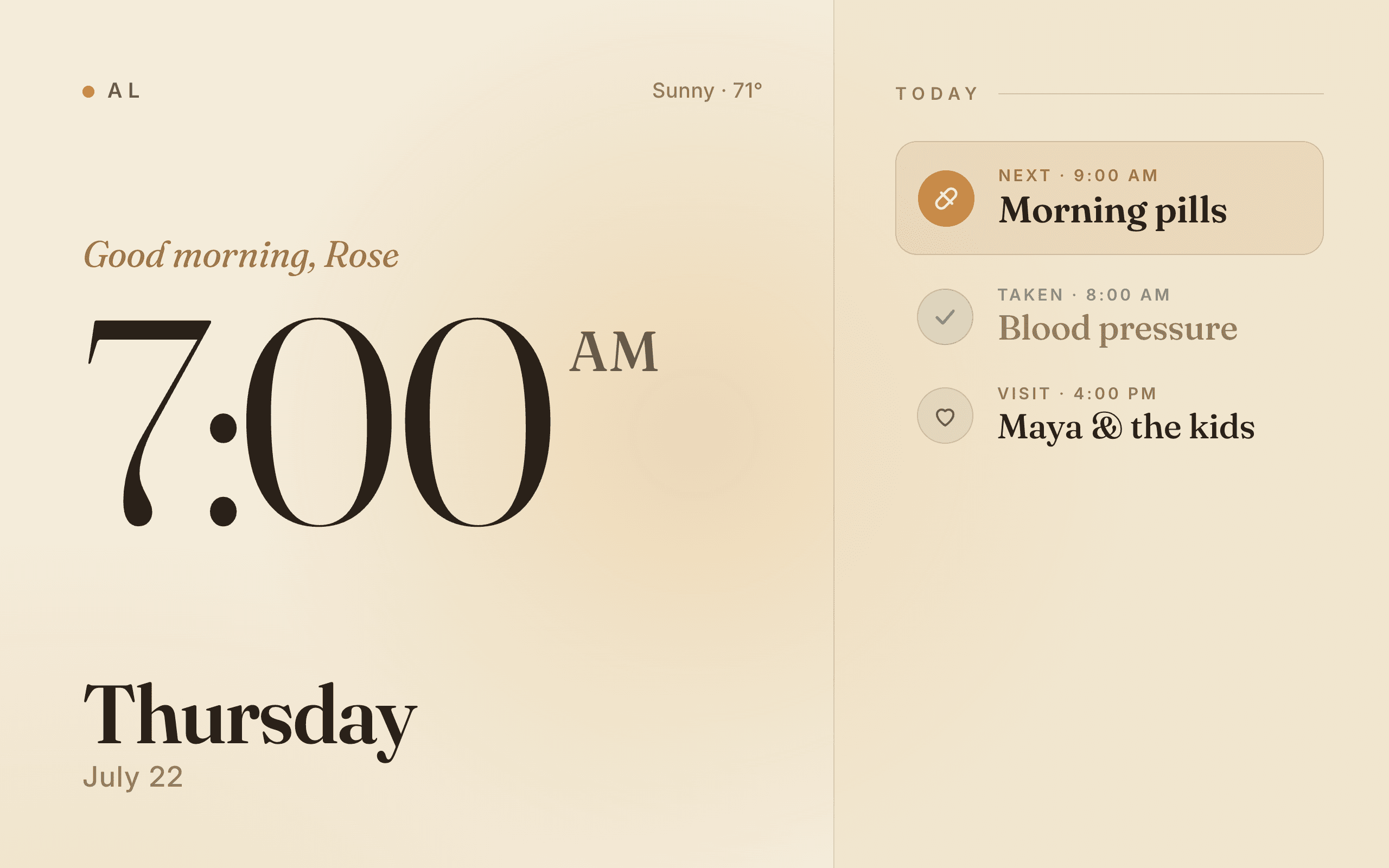
AL lives on the counter, next to the kettle. Nothing to unlock, no apps to open, no buttons to find. It stays quietly awake, and a small always-on screen shows the shape of the day at a glance: the time, the next dose, a gentle reminder or two. Say the wake word from across the room, and it’s already listening.

AL on a wooden nightstand at dawn: a small oak-and-felt device whose warm always-on screen shows the time, the day, and today's plans, with a little tray dispensing the morning's pills, beside a mug of tea.
AL on the nightstand: always awake, never in the way, and the morning’s pills, right when they’re due.
AL's always-on display: 7:00 AM, Thursday, July 22. A ‘Today’ panel shows the next dose of morning pills at 9:00, a taken blood-pressure dose, and a 4:00 visit from Maya and the kids.
The always-on display: the time of day, medications due and taken, and today’s plans, in warm, easy-to-read type.

Before you go

Be one of the first families.

Pilot homes are opening soon. Leave your name and we’ll reach out.

Private by design

What happens at home, stays home.

Everything AL knows about your family exists for one reason: caring for the person in front of it. Your conversations are never used to train AI models. Nothing is sold or shared, and nothing is used for advertising. No third parties are listening.

  • Never used for training

    Conversations and memories stay your family's. They are not a dataset.

  • Never sold or shared

    No advertisers, no data brokers, no exceptions.

  • Yours to see, yours to delete

    The family decides what AL keeps. Ask, and it forgets for good.

  • Held to a higher bar

    We are working toward SOC 2 compliance, the standard for handling sensitive data with care.

If AL could help someone you love, we’d like to meet you.